If you’ve ever stood on a factory floor watching a pick-and-place robot dart across a work area with precision, or observed a 3D printer moving a print head exactly 0.1mm to deposit a layer of plastic, you’ve interacted with linear modules—those unsung components that turn rotary motion into controlled, linear movement. As a supplier of slide tables and linear modules, I talk to engineers and production managers every week who are stuck choosing between two of the most common options: ball screw linear modules and belt-driven linear modules. Most are under the impression these two are interchangeable, but after 12 years of working with both, I can tell you skipping the deep dive here leads to costly downtime, overspending, or underperforming systems down the line. Slide Table and Linear Module
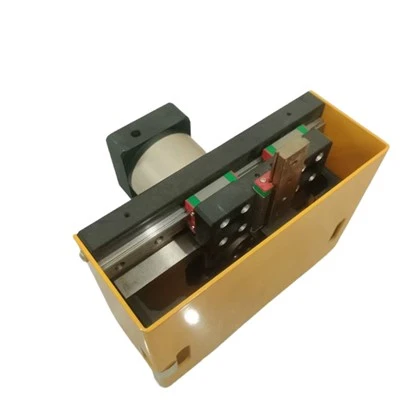
Let’s start with the basics that most buyers gloss over. A ball screw linear module uses a precision-machined screw shaft, ball bearings, and a nut assembly that threads onto the screw. When a motor spins the screw, the ball bearings roll between the screw and nut, converting that rotational motion into ultra-smooth linear movement. It’s the same core mechanism that’s been the workhorse of machine tools and automation for decades. A belt-driven linear module, by contrast, uses a looped toothed belt wrapped around two pulleys (one driven by a motor, one idling) and a carriage that clamps onto the belt. Spinning the pulley pulls the belt, which in turn moves the carriage along the module’s rail. At first glance, both seem to do the same thing—move a load along a straight line—but dig into the details, and the differences are dramatic enough to make or break a project.
Let’s start with precision, the non-negotiable for any application that involves measurement or part mating. Ball screw modules deliver repeatability (the ability to move to the same position 10,000 times in a row) of +/-0.02mm or even better, depending on size and quality. Their closed mechanical loop—where the screw’s rotation directly dictates the carriage’s position—eliminates almost all play. But they shine most in positional accuracy, or how close the actual carriage position is to the target. A ball screw’s rigidity means it doesn’t stretch or deflect under load, so if you tell it to move 500mm, it will land almost exactly there, even with a 50kg load. Belt-driven modules, by comparison, typically have repeatability of +/-0.1mm to +/-0.5mm. That gap comes down to the belt’s flexibility: under heavy load, or over long travel lengths, the belt can stretch slightly, which means the distance between the pulleys changes, throwing off the carriage’s position. For example, if you have a 2-meter belt, a 1mm stretch in the middle means the carriage will be off by 0.5mm when moving to the far end of the module. Some high-end belts get close to ball screw performance, but they cost almost as much as a mid-range ball screw and still fall short for critical applications.
Next up is load capacity, a big one for machine builders moving heavy parts, packaging materials, or large payloads. Ball screw modules are built for rigidity, and that translates to high dynamic and static load ratings. A standard 100mm wide ball screw module can handle up to 100kg of dynamic load (meaning a moving payload) on the horizontal axis, and twice that on the vertical axis, without significant deflection. That’s because the screw and nut distribute the load evenly along their threaded contact points, so there’s no point of concentrated stress that causes bending. Belt-driven modules, though, have a load limit tied directly to the belt’s tensile strength and the clamping force of the carriage. Even a heavy-duty industrial belt-driven module tops out at around 50kg dynamic load for a similarly sized unit, and that number drops sharply if you’re running a long travel length. Go beyond 2 meters of travel, and the belt will start to sway under load, limiting how much weight you can safely move. I’ve seen a few customers try to cram a 100kg part onto a cheap belt-driven module, and it wasn’t long before the belt stretched enough that the carriage started skipping teeth on the pulley—complete system failure before the end of the first production shift.
Speed is another make-or-break factor, and here belt-driven modules pull ahead by a mile. Because they don’t have a heavy screw shaft spinning inside them, they’re lighter overall, so they can accelerate and decelerate much faster. A typical belt-driven module can hit top speeds of 5m per second, with acceleration rates of up to 5G—fast enough for high-speed pick-and-place, food packaging, or sorting systems that move parts every 0.5 seconds. Ball screw modules, by contrast, are limited by the rotating mass of the screw. The longer the screw, the more momentum it has to spin up, so top speeds usually cap out at around 2m per second, with acceleration rarely exceeding 2G. If you’re building a system that has to move 100 times an hour, a ball screw will work, but you’re going to wait longer between cycles than you would with a belt-driven unit. That said, speed isn’t always better: if you’re running a high-load application, fast acceleration with a belt-driven module can snap the belt, so you have to balance speed with load to avoid breakdowns.
Travel length is another area where the two modules diverge, and it’s one that trips up new buyers all the time. Ball screw modules have a maximum practical travel length of around 6 meters. Push beyond that, and the screw starts to bend under its own weight when it’s not supported on both ends, leading to positional error and increased wear on the nut. You can add support bearings along the screw to extend travel, but that adds cost and complexity, and it introduces points where friction and error can build up. Belt-driven modules, on the other hand, can easily handle travel lengths of 10 meters or more. The belt is light, flexible, and doesn’t sag under its own weight, so you can run it over long distances without needing extra supports. That’s why belt-driven modules are the go-to for things like gantry robots, long-axis material handling, and large assembly lines where a part has to move the full length of a 10-meter work cell.
Maintenance is a big talking point these days, as facilities look to cut downtime and extend component life. Ball screw modules require regular lubrication of the screw and nut, usually every 6 to 12 months, depending on load and speed. Skip that, and the bearings can wear out, leading to increased play and eventual failure. They also need to be kept clean: dust and debris can get between the screw threads and the nut, causing abrasion that accelerates wear. Belt-driven modules have lower overall maintenance requirements, but they’re not zero-maintenance. The belt will stretch over time, so you need to adjust tension every 12 to 24 months, and eventually, it will wear out and need replacement—usually every 3 to 5 years, depending on use. Some industrial belts are designed to last longer, but they still don’t have the same lifespan as a well-lubricated ball screw module, which can run 10+ years with minimal service. The tradeoff here is that belt replacement is much faster and cheaper than replacing a ball screw nut, so if you’re looking for low-fuss upkeep, belt-driven might edge out ball screw—just don’t skip the tension checks.
Cost is the final piece of the puzzle, and it’s not as straightforward as you might think. For short travel lengths (under 2 meters), a basic ball screw module is usually less expensive than a comparable belt-driven unit. The parts are simpler for small sizes, and the manufacturing process for short screws is cheaper than for long belts. But once you go beyond 2 meters of travel, that flips. A 5-meter ball screw module requires a precision-machined 5-meter screw, which is expensive to fabricate and transport, whereas a 5-meter belt is just a standard industrial belt, cut to length and wrapped around pulleys. For long travel, a belt-driven module can be 20-30% cheaper than a ball screw module of the same load rating. That said, you have to weigh upfront cost against long-term performance: if you need the precision of a ball screw for a medical device assembly line, saving $500 on a belt-driven module that can’t hold position will cost you thousands in scrap parts.
So how do you actually choose between the two? Let’s break it down by use case to make it simple. If you’re building a high-speed pick-and-place system, food packaging line, or sorting robot where speed is king and you’re moving light loads under 50kg, go with a belt-driven linear module. If you need precision for medical device assembly, CNC machine axes, or moving heavy parts over short distances, a ball screw linear module is the right call. If you’re building a gantry robot for a 10-meter assembly line, you’ll almost certainly need a belt-driven module, since a ball screw would be impractical at that length. If you’re moving a 100kg payload that has to stop exactly at 1mm increments, don’t even look at a belt-driven module—you’ll regret it.
I’ve walked both paths with my own clients. A few years back, a customer came to me wanting to replace their ball screw modules on a high-speed bottle filling line with belt-driven ones, claiming they’d save money. We ran a test: the belt-driven module was faster, but within 3 months, the stretching belt was causing misaligned caps, leading to 200 spoiled bottles a day and $12,000 in lost revenue. We swapped them back to mid-range ball screw modules, and the downtime dropped to almost zero. On the flip side, another client needed a gantry system that moved 8 meters across a warehouse floor to load pallets. A ball screw would have cost them $15,000 for the axis, while a belt-driven unit was $9,000, and it worked perfectly for their 100kg pallet load, with no precision required beyond moving from Point A to Point B quickly.
Manipulator At the end of the day, there’s no “better” linear module—only the right one for your application. The biggest mistake I see engineers make is assuming that one size fits all, or chasing the lowest upfront cost without considering long-term performance. If you’re working on a new project, and you’re not sure which module is right, don’t guess. Reach out to our team here to discuss your load, travel length, speed requirements, and precision needs. We don’t push one product over the other; we’ll help you pick a solution that fits your budget and keeps your system running reliably for years to come.
References
- Bolton, W. (2015). Mechatronics: Electronic Control Systems in Mechanical and Electrical Engineering. Pearson Education.
- Todd, R. H., Allen, D. K., & Alting, L. (2012). Manufacturing Processes for Engineering Materials. Pearson.
- Linear Motion Guide Association. (2021). Linear Motion Technologies Standard Specifications. LMGA Publications.
Yangning (Xiamen) Intelligent Technology Co., Ltd.
With abundant experience, we are one of the most professional slide table and linear module manufacturers in China. As we have world-leading production equipment and strong manufacturing capabilities, we warmly welcome you to buy bulk advanced slide table and linear module from our factory. Customized orders are welcome.
Address: Room 307-2, No. 15 Duiying Road, Software Park Phase III, Torch Hi-Tech Zone, Xiamen, Fujian, China
E-mail: mia@ynautos.com
WebSite: https://www.ynautos.com/
